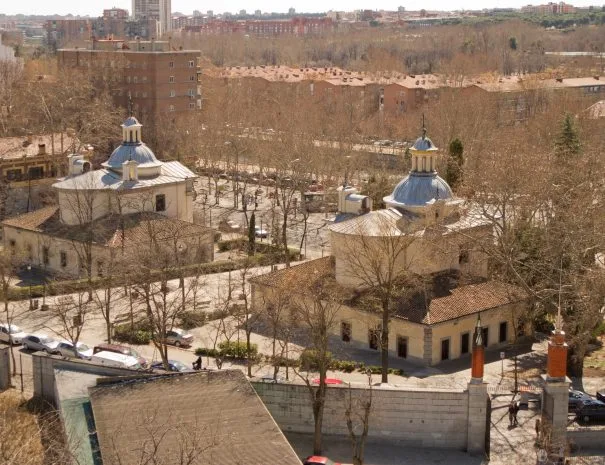
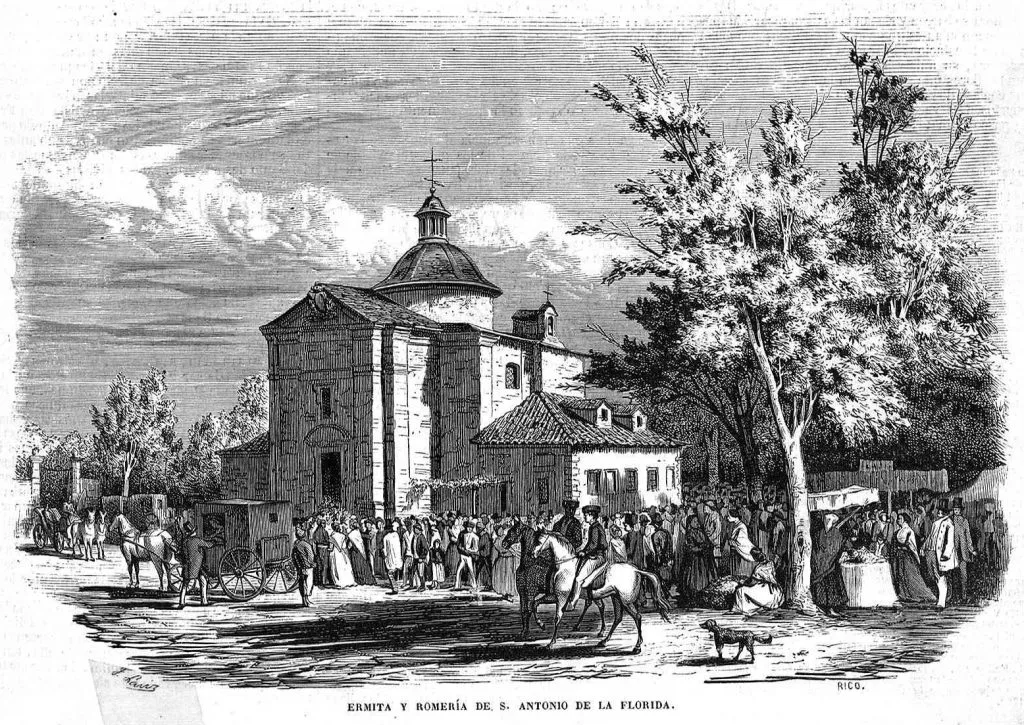
Today we want to tell you about this hermitage, considered the only survivor of the three hermitages dedicated to Saint Anthony that once stood on the outskirts of Madrid. Next to what are now the railway tracks of Príncipe Pío was the "cuesta de areneros", where today there are two completely identical neoclassical churches: the hermitage dedicated to San Antonio and its twin. The reason: in 1881 the hermitage was converted into a parish, and worship seriously damaged Goya's paintings — the smoke from the candles, the incense, and so on caused the frescoes to deteriorate at lightning speed. With this in mind, it was decided to leave this hermitage as a museum and build a new one, identical to the previous one, so that mass could continue to be held there.
Let's go back to its origin. In 1720 the Guinderos congregation commissioned one to José de Churriguera — a very small church that would be torn down years later. Later, the best mayor Madrid ever had, King Carlos III, drew up a plan to widen the main exits of Madrid, which also affected the hermitage area and led to a second construction in the 1760s. But the definitive one came under Carlos IV, who commissioned Filippo Fontana to design a new hermitage on the land he had just acquired in the Florida area. He produced a simple Greek cross floor plan with a dome on pendentives, all in a fully neoclassical style.
- 1790: Fontana is appointed architect.
- 1794: construction of the hermitage begins.
- 1798: as Court Painter, Goya begins decorating the dome.
- 1799: Goya's paintings are completed.
To understand what happens between those pendentives, we have to keep in mind that in barely a year several important events take place that will shape the painter's life: on the one hand, he already knows he is ill, and decides to accept his deafness and continue to be Court Painter; on the other, the Government of the Enlightened is in power, which favors him and makes this a happy moment for Goya, even though he will leave his role as director of the Academy of Fine Arts (which he obtained in 1795) due to his impending illness.
It's also worth keeping in mind that Goya wasn't an expert fresco painter and even so resolved the dome's decoration very competently. In his youth, before settling in Madrid, he had worked on some frescoes at the Basílica del Pilar in Zaragoza, so it wasn't the first time he faced a challenge like this.
The painter masterfully arranges around fifty figures around a balustrade, his anchoring device for the dome's half-orange shape — a deceptive and realistic balustrade that he accentuates with children climbing and playing among the figures in very diverse poses. He groups the figures through gestures and compositional postures that turn the piece into something of unmatched richness.
And what does this scene show? It's the miracle in which Saint Anthony resurrects a murdered man to question him and, by doing so, prove the innocence of his father, who had been falsely accused. The scene fills the entire dome, 6 meters in diameter. Goya wants to represent the human side of Saint Anthony through this specific chosen scene.
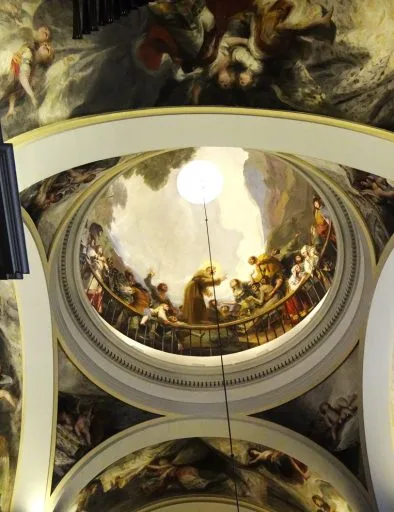
The figures move through a place that doesn't really locate us, but they seem to represent the people watching: Madrid bearing witness to that miracle of one of its favorite saints. Veiled ladies, chisperos, gentlemen, majas, children…
But not everything stays in the dome — in a second composition the Zaragoza-born painter depicts an apotheosis of angels that fills the pendentives, the springing walls, and the half-dome over the high altar with the symbol of the Holy Trinity. While in the dome an astonishing and strange world of the human condition appears, on the vaults and walls men have become angels, creating another world of beauty and luxury all around. As if it were a theater curtain, the angels hold the drapery of that Heavenly Court, dressed in rich fabrics and colors. These cherubs are better known as "las ángelas" because they have a fully feminine appearance.
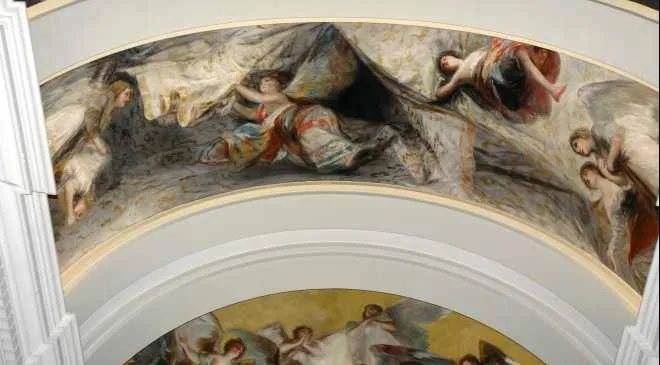
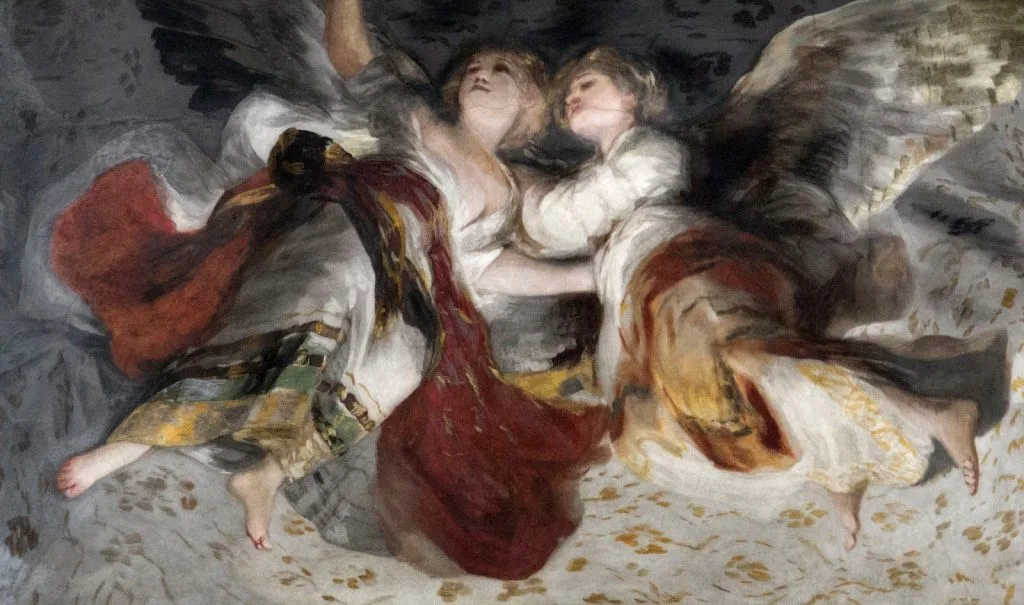
Goya will take 6 months to make these paintings, together with his assistant Asensio, and will resolve the whole with loose, energetic and very specific brushstrokes, made of patches of light and color. Their contrast and vibration even recall what the Impressionists would later do on canvas. Without a doubt, he breaks the precepts of religious painting and creates an aesthetic recreation of an imaginary world, where reason always overcomes faith.
At the foot of the altar his remains also rest, brought from Bordeaux (where he would go into exile at the end of his life) but without the painter's most valuable part — his mind. He was buried alongside his friend Martín Miguel de Goicoechea, and the remains of both today lie in the hermitage dedicated to Saint Anthony, beneath these brilliant paintings that mark a before and after in the history of art.