What we don't show you of the Prado
We're launching a new series in which we'll take a close look at some of the most notable works in the Museo del Prado that we don't cover in our guided visit.
The chosen work was painted in the 19th century by a truly singular figure. We're talking about one of the great names of Spanish art, Eduardo Rosales. His sordid, sickly and solitary life in some way fueled his fame in Spain, but he is also admired for his talent and originality, giving the historical genre a fresh turn and looking to Velázquez's realism, always from within the purist movement in which he was trained.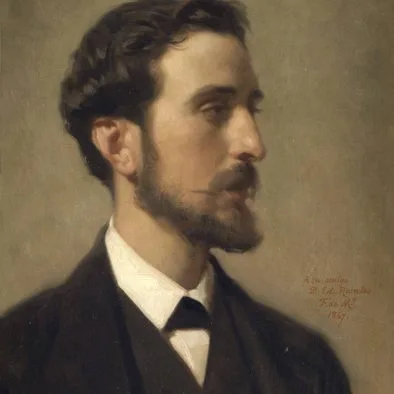
Eduardo Rosales is one of the most relevant artists of his time and one of those whose work the Museo Nacional del Prado in Madrid currently holds the most of. In search of new forms of pictorial expression that moved away from the techniques followed by his close neoclassical friends, experimenting in absolute freedom, this is how Rosales arrived at what would be his last great work, taking as his starting point the Velázquez heritage he had been acquiring over time.
The Death of Lucretia
It was in 1871 when he painted The Death of Lucretia for the National Exhibition, where it won one of the runner-up prizes and which the painter himself always considered his best work. However, it was surrounded by criticism and great controversy regarding the mastery of its execution.The subject chosen in this painting is the slow agony of one of the most virtuous women of the Roman period, the patrician Lucretia, whose death would unleash important consequences for the politics of the moment — her suicide after being raped by the son of the king of Rome ultimately led to the proclamation of the Roman Republic in 510 BC. A before and after for history.
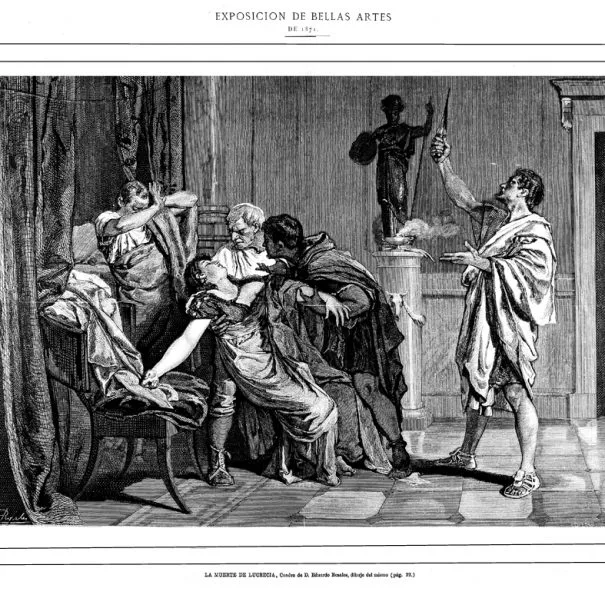
We can see the scene takes place inside Lucretia's chambers, where the violated body falls dramatically into the arms of her father Lucretius and her husband Collatinus. It is upon them that the dishonor has truly fallen, and the young Lucretia, in a heroic act and setting an example to society of her moral courage, decides to take her own life to definitively end the affront to her family.
To the right of the protagonists stands Brutus, who raises the knife she has plunged into her own heart and swears revenge. And behind the body of the deceased, another patrician in a blue cloak hides his frightened face at Lucretia's tragic end.
The artist moves away from a purely political reading to turn this most intimate scene, in the protagonist's own room, into a spectacular form of human drama, accentuating that this was the trigger for the change of course in the history of Rome and Europe. Using a very simple classical composition in the manner of Jacques-Louis David, the pale and collapsed corpse is the focal point around which the rest of the figures move. By interspersing very different positions, the drama of the moment is amplified, while cool tones and a shadowed, dim room reinforce it.
Although his modernism wasn't truly understood by the institutions of his time, his synthetic visual language and the loose execution he adopted in the final stretch of his career would become the seed of what younger generations would later follow. Rosales is at the same time the modern, immediate language of Spanish Romanticism and the deepest classical tradition.