El Escorial is one of the quintessential tourist destinations both for Madrileños and for the many national and international visitors who feel drawn by its heritage and cultural attractions, as well as the beauty of the town itself. However, often, despite recognizing its value and knowing of its renown, we don't really stop to think about either the reason or the circumstances that gave rise to its creation. Could that imposing religious monument on the outskirts of the Sierra de Guadarrama have a lot more behind it? Let's find out.
It's hard to think of anything European that didn't revolve around the Hispanic monarchy during the 16th century. It was with Emperor Carlos I, grandson of the Catholic Monarchs, and later with his son Felipe II, when the House of Austria managed to become the great European power that dominated every sphere — and to which all eyes turned.
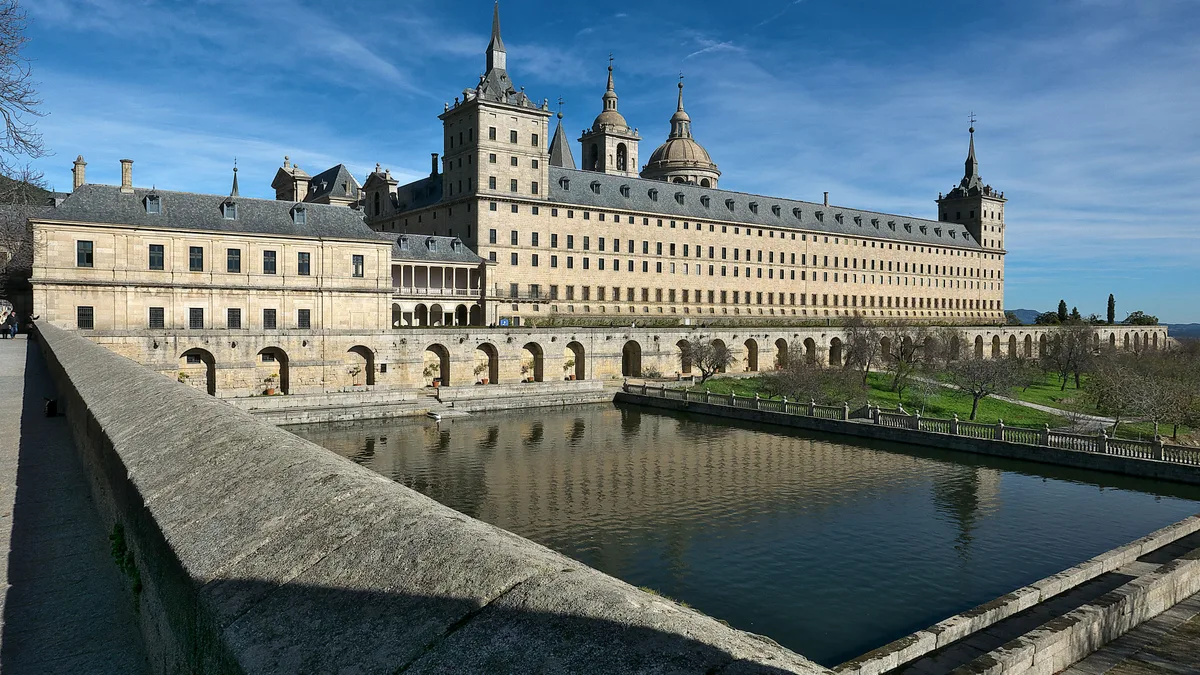
To understand that the creation of El Escorial in the mid-century was an unprecedented event for Spain, we have to look back and grasp the role buildings of this type had played for society up to that point. Majestic cathedrals rising imposingly, built by the clergy and the Church in medieval times, just like ambitious monasteries painstakingly raised for their pretensions, or great palaces that the nobility used as they pleased to put on a display. There's no perceptible interest in attracting distant visitors, nor in making eternal buildings that would remain in historical memory throughout the centuries.
So we're left with something unprecedented — a building of similar characteristics but conceived in the mind of one man (not just any man), and tied to him for the rest of his days. The construction of El Escorial is born as a symbol — an emblem that would outlast the good times and the bad, even labeled a "wonder of the world" and also criticized on numerous occasions, seeming to endure as the Spanish spirit that resisted the changes of the new doctrines of Catholicism. Knowing this, it's essential we look at it with different eyes, and that the central role it plays be analyzed from the reality of its creator, Felipe II, and the Spanish era in which he lived.
Felipe is a figure who shouldn't be understood only from the date of 1556, when he inherits the throne of Castile and Aragon — he should be studied from 1548, when he is still prince and begins to have a great artistic and collecting activity, surpassing that of his ancestors and his father, equipping him to undertake a few years later the great work of El Escorial. As for his personality? Of great temperament though always very reserved, today we have to understand his position from that of a cultured, humanist, devout man who wanted to leave a legacy that included much more than any other: union, power, spirit and monarchy.
Why San Lorenzo and not another saint? Several coincidences. The first is that on August 10, 1557, the feast day of Saint Lawrence the Martyr, the Spanish troops managed to win the battle against the French near San Quintín. It was a decisive battle that made Felipe one of the last Habsburgs to lead his army to such a victory, comparable to that of his father at Mülberg. The second coincidence speaks to the great devotion Felipe had professed since childhood to this Spanish saint, leading him not to doubt for a moment to whom the temple he intended to erect would be offered.
He would put it under the rule of the Order of Saint Jerome, for which — like his father the emperor — he had a great preference. Not only because the friars of this Order had a strict discipline, but because they had great experience in construction, with very good architects among them. Plus, following the king's wish, the community of monks also included the students of the elementary school and the students of the college, as well as the administrative staff and the king's servants, who would even take care of the gardening.
But what Felipe II wanted to do with El Escorial was not exclusively a monument commemorating his victory, a family pantheon or a sanctuary — what he wanted was to represent the result of a glorification of Spanish royalty. A building where the union between spiritual and temporal power would be made manifest, and how the latter is supported and sanctioned by the former. In short, a building that would be the best expression and the best vehicle of propaganda for the solidity of an economic-social, political and religious system (his reign).
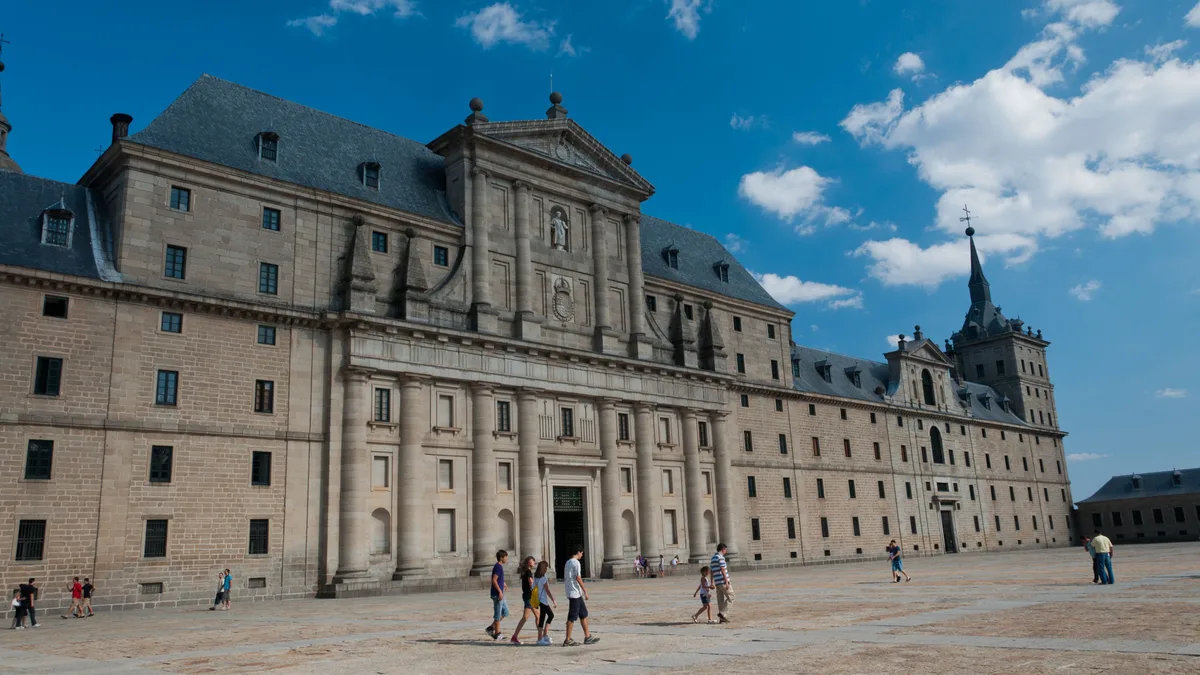
Beyond all this, Felipe would use this new building as a family mausoleum and a place of retreat. He lived there, far from the bustle of the Court in the capital, since from this place in the Madrid Sierra de Guadarrama he could more peacefully govern his possessions efficiently and control the political mosaic that made up his kingdoms. For this reason too, not only monks and mathematicians but also doctors were consulted for the choice of site for the Monastery's construction. It's curious to note that the monarch also had a small lookout built on a slope near the town to observe how the Monastery's works were progressing during construction — currently called the Silla de Felipe II, from where he kept watch impassively.
But beyond all of this, this great work has a meaning analogous to that of the Royal Chapel of Granada, which, founded by the Catholic Monarchs, had been the symbol of the Reconquista. El Escorial wanted to be seen as a new temple of Jerusalem, uniting the fight against the Protestants and against the Turks. The latter were defeated on October 7, 1571 by the fleet of the Holy League at the Battle of Lepanto, while El Escorial was being built.
We come to the conclusion with all this that in this monumental complex, Felipe II identifies his fight against heresy, turning it into the symbol of the Counter-Reformation in Spain. The king's entire life would revolve around this monument, leaning all his Catholic faith on it.
Its purpose thus responded to the intentions of the Council of Trent, already opened in the time of Emperor Carlos. But it doesn't only stand as a religious symbol — it's also a cultural one, since its construction style and the fact that among its rooms there's a seminary, a university and a tomb for kings, also makes it a symbol of Christian humanism. And not only that — with its revolutionary architecture full of austerity and simplicity in the face of the busy Castilian Plateresque style of this era, it represents a turning point in Spanish art and also in European art.
Thus we close one of the many chapters that can be written about this incredible and grandiose monument, whose architectural, cultural and Catholic value surpasses everything we believe. A primary monument to visit and to dive into without a doubt, since it is magnificent across a wide variety of fields.