Part of the beauty of the city of Madrid lies in those monuments that have stood for years in privileged spots and are so photographed and admired by tourists — yet not so much by Madrileños, since often we don't know their symbolism or meaning. They're part of our visual landscape, and we've seen them so many times that they feel familiar and we barely notice their craftsmanship.
If we travel back in time, during the reign of Carlos III one of the main reforms carried out on the capital's avenues and walkways was known as the Reforma del Salón del Prado — turning this area of Madrid into a promenade full of beautiful gardens and fountains. Within this reform, the project carried out by the architect Ventura Rodríguez stood out — he designed a set of fountains that include the Fountain of Cibeles and the Fountain of Neptuno, the Fountain of the Alcachofa (currently located in Parque del Retiro), the Cuatro Fuentecillas and the Fountain of Apollo or of the Four Seasons.
Today we want to focus all our efforts on getting to know in depth one of the fountains that made up the project of the Salón del Prado axis. The unknown sister of Cibeles (to the north) and Neptuno (to the south) — and unlike them, she doesn't share the same popularity nor is she equally visited, probably because the other two are located in much more visible spots, meeting points where really important streets converge, and also because both of them are especially tied to football celebrations.
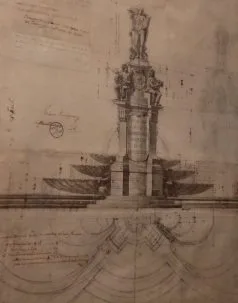
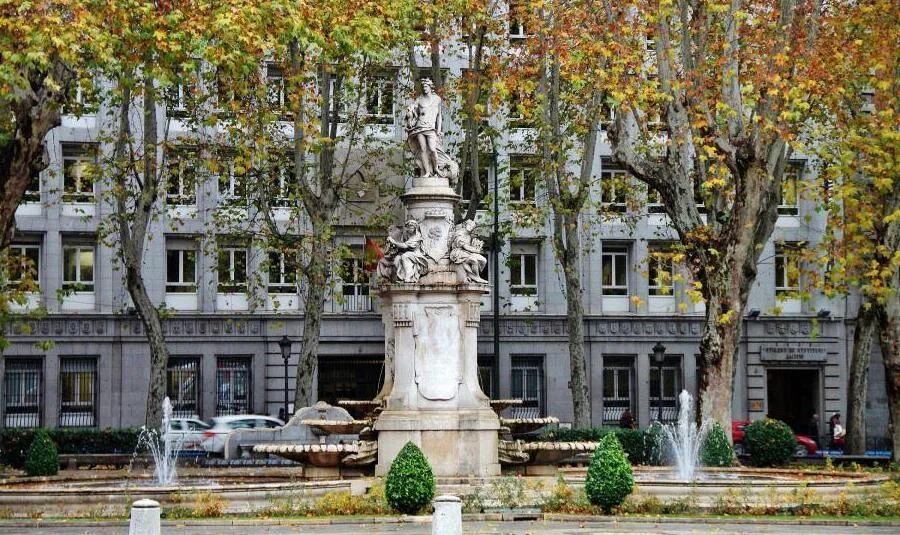
We're talking about the Fountain of Apollo, which sits specifically on the central sidewalk of Paseo del Prado, creating a small plaza that allows for better contemplation. However, of the three fountains, it has to be said it is by far the worst preserved. Although it has undergone several restorations, the result was of higher quality on the other two gods of the Paseo.
Apollo is the god of the arts, medicine and poetry, enemy of darkness and pursuer of crime. But his real interest here comes from the fact that he is the most charismatic representative of the Enlightened spirit that the Bourbons in the 18th century wanted for the Salón del Prado — as a center designed to foster the development of culture and the sciences. Carlos III undertakes a great project and wants to crown it with symbols of reason, culture and science.
On top of that, given the complexity of carrying out this Madrid project, a large number of sculptors were employed to create the fountains. The final model of this fountain was commissioned in 1781 from sculptor Manuel Pérez who, however, died in 1797 before being able to fully finish the figure of Apollo. Eventually the project would be completed under Carlos IV, in 1802, probably with the process accelerated for the wedding of the infante Don Fernando to María Antonia of Naples.
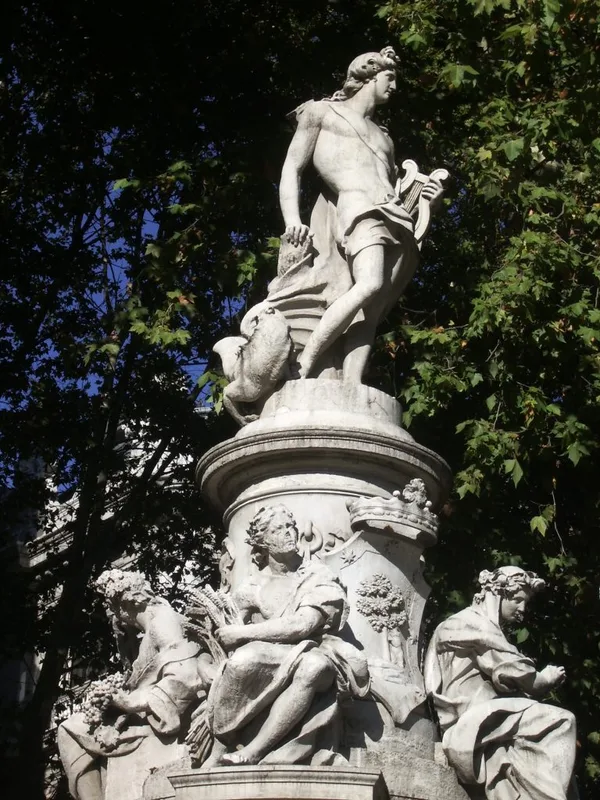
In any case, despite its poor state of conservation, this statue is considered one of the best classical works erected in Spain due to the elegance of its proportions and the capture of the divine gesture and balance. Apollo appears holding a lyre and accompanied by the allegorical sculptures of the Four Seasons — since, as god of the Sun, the birth and passage of the seasons depend on him.
On the trunk of the statue are the allegories of the four seasons holding their respective attributes: a basket of flowers, a sheaf of wheat, a crown of vines and bunches of grapes. Each one is made with ingenious mastery and a delicate touch.
This fountain is one of the most beautiful we still have on our beloved Paseo del Prado, and without a doubt, a reference and a symbol that the Enlightenment arrived in the capital to stay.