MADRID SONGS: "THERE'S NOTHING HERE"?
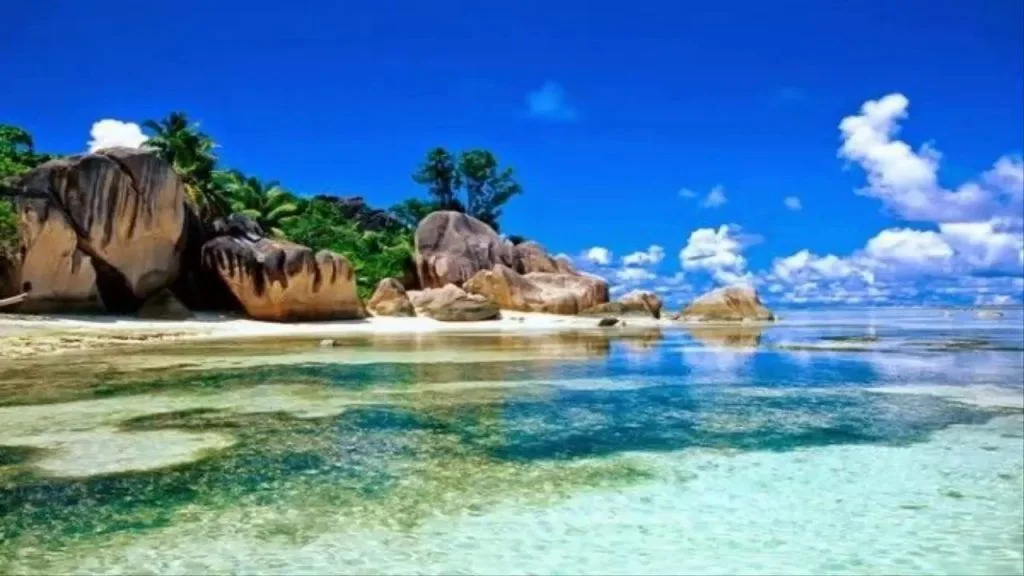
The first thing I do when I get up (and I'm not sure that's the right way to start the day) is read the news headlines. Almost always they're not pleasant, but the other day I found one that especially made me remember a song everyone has heard, and that made me smile thinking of Madrid. The headline read: "Come and discover the first beach in Madrid with a Blue Flag." I had to read it several times because I thought I was still dreaming.
When I finally started to take in what the headline said, I remembered a song that played during the Movida Madrileña, that period of musical "splendor" in the capital but also throughout Spain.
We have to go back to 1986: a few young guys start getting together with some instruments, start playing in dive bars in the Ascao neighborhood, and give themselves a very fresh name: Los Refrescos. Soon, a very catchy song flows from their pens. I think you already know which one I'm talking about. "Aquí no hay playa" ("There's no beach here").
A song that begins with that frenetic ska rhythm, with a bass that gets into every possible cavity of your brain and a drum kit that won't stop changing the beat while the chorus starts saying words I've never understood. After almost 30 seconds of that exhausting intro, the drums change rhythm again and Mr. Bernardo (the singer) starts listing off some important spots in the capital that "we can have":
- Retiro, Casa de Campo and Ateneo: the first two are the two great lungs of the city of Madrid, one at each end. The Ateneo is a great institution located on Calle del Prado, one of the literary references of all Spain.
- A thousand cinemas, a thousand theaters, a thousand museums: when this song was released, all of Gran Vía was a tangle of lights, cinemas, theaters and premieres. These days, the cinemas are increasingly moving to shopping centers and the theaters are more spread out (between Callao and Plaza de España there are 4 theaters and 3 cinemas). Museums — I'm not sure if there are a thousand, but almost. And among the best in the world.
- Corralas, organillos and chulapas: how we love walking through the Lavapiés neighborhood and finding those typical corralas of old Madrid. And just recently, on San Isidro day, we ran into the organillos playing and everyone wearing the traditional outfit: the chulapos with their parpusa (cap) and waistcoat, and the chulapas with their long dress and shawl.
- The capital of Europe: maybe in the song's day Spain had more power (or didn't) in Europe, but today I'm afraid there are others — or rather, other women — who have more power. What we are is the capital of Spain.
- We can win La Liga and the Cup: pure football. Although this year… let's see if at least we can land the Champions League…
- Hipódromo, Jarama and Complutense: the Hipódromo de la Zarzuela is located outside Madrid, commissioned back in 1931. Its grandstands have been declared World Heritage. Continuing along the highway, we come across the Circuito del Jarama, where for a few years the Spanish Formula 1 Grand Prix was held. As an anecdote, this circuit was the last place driver Gilles Villeneuve was seen alive (he would die the following weekend in the Belgian race). And arriving back in the city, we come to the Complutense University complex, whose ranking on the global scale leaves a lot to be desired.
- And right next door… Moncloa: where the same old crowd remains. Where the Presidents of the Government live.
- The command of the Empire: in the days of Felipe II, when we had that empire on which the sun never set, it was decided to move the capital of Spain to Madrid.
- TV and Los 40 Principales: many national TV networks set up their headquarters in the Spanish capital. And one of the most important music radio stations has its headquarters in a penthouse on Gran Vía. Every week they release the world's number 1 song. I bet "Tu canción" isn't even in the top 300.
- The Cortes: the Congress of Deputies, in the Plaza de las Cortes, next to Neptuno (congratulations to the Atlético fans!), and the Senate, next to the Royal Palace, make up the country's two most important democratic institutions.
- The Bear and the Strawberry Tree: symbol of Madrid that we can see at Puerta del Sol and at many other points on the Madrid pavement (you have to look more carefully).
- Cibeles: the eternal goddess who watches over and protects us next to the City Hall, the Palacio de Linares, the Bank of Spain and the Palacio de Buenavista. A goddess who has always sheltered us and given us security.
- Torrespaña: that "lollipop" we always see when we get a panoramic view of Madrid. An antenna built to broadcast the 1982 Football World Cup, and one we've grown fond of since. Thanks to it, terrestrial TV channels have reached our homes and we can listen to the radio. So yes, we barely have anything. And there's still much more they didn't say. But whether you call out Leguina, Tierno, Barranco, Aguirre, Carmena, or whoever's in charge… now we can finish this song and say: "when summer arrives… well, well, here there IS a beach". Will it really be like that?