On Facebook the other day, in our ¡Descubriendo Madrid! section, we told you about the Sistine Chapel of the Spanish Baroque, San Antonio de los Alemanes — and today I'd like to bring you closer to its neighbor, the Iglesia de San Plácido. Founded between 1620–21, it was the old church of the Monasterio de la Encarnación Bendita, built in order to house a community of Benedictine nuns who came from a convent in Navarra, "led" by an aristocratic lady, Teresa Valle de la Cerda — after being repudiated from a marriage with D. Gerónimo de Villanueva (Protonotary of Aragon).
Initially the convent was founded in some houses belonging to this figure, and later in 1641, the building work was carried out, placed under the spiritual direction of the priorate of San Martín de Madrid. The first project for this building was presented by Fray Lorenzo de San Nicolás. He presented a small church — barely visible from outside — with a longitudinal cross-shaped plan, although it gives a sense of centralization, with a short presbytery and nave, spacious crossing arms… all of which leads from the floor plan to the octagon of the hemispherical dome. It was built in a very sober, almost masculine style, following what Vitruvius had said about the ancient orders. In 1903 it was demolished, and what is seen today is the work of 1912. In 1943 it was declared a National Monument.
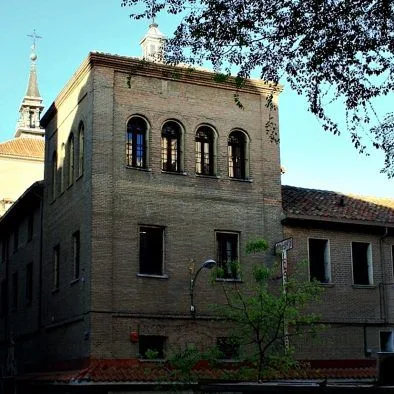
It's one of the buildings preserved in the best condition. Despite all the destruction of the pre-war Spanish period, this building managed to be saved. The losses it has had have come from reconstruction needs to make it inhabitable as a convent.
The building has decoration done by the best artists of the Madrid Baroque, although its trajectory is rather spread out over time. The Villanueva family continued to protect the nuns and as a result helped the decoration go forward. The first thing laid out was the altarpiece — a characteristic example of an altar pala — which housed the famous Crucified Christ by Velázquez. It's an altarpiece of columns with an architectural structure with theatrical sense. It took nearly 10 years to complete (finished in 1668 by C. Coello).
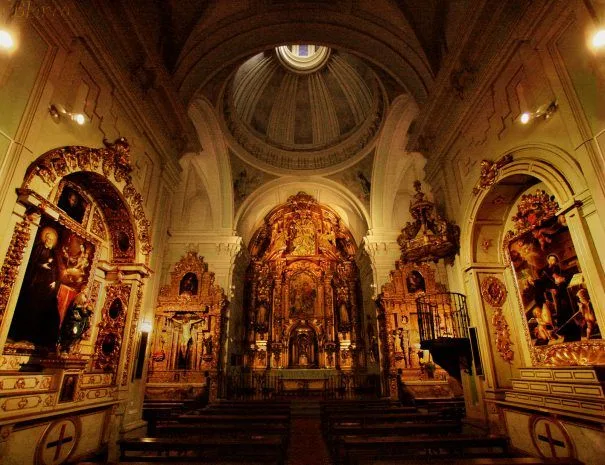
The dome was made around 1660 by Francisco Rizi, who was already a painter to the king, and has decoration of an ornamental nature based on cornices, vegetal moldings, or garlands imitating gold… In the central medallions appear allegories of what the Order of San Benito is spreading, through prophets and sibyls, or the history of the order itself through figures like San Mauro or San Plácido.
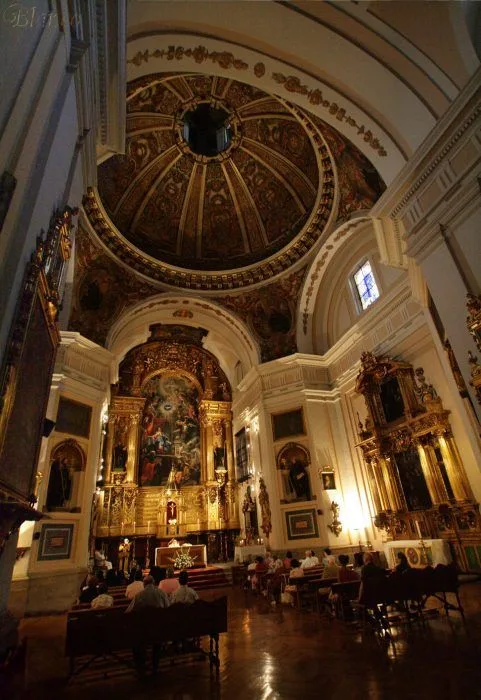
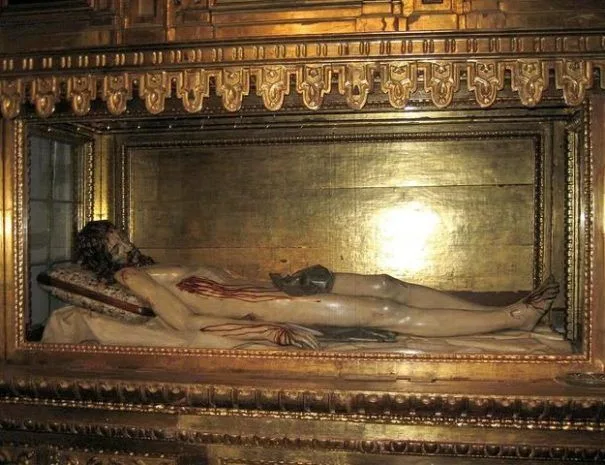
On the pillars, a series of niches with sculptures related to the Marian sphere; above them, a series of paintings that would represent stories complementary to these saints, all of them in grisaille; for example, San Ildefonso has above him the scene of the imposition of the chasuble by the Virgin. The key piece of the church is a Recumbent Christ by the great Gregorio Fernández, located in one of the chapels.
But what's really curious about this church isn't only its layout — it's two stories that earned it the name "cursed":
1st: A supposed demonic possession, surely brought on by the convent's own labors, the long fasts and extensive periods of prayer, of 25 nuns of the convent, among them the founder, Teresa Valle de la Cerda. In their ramblings they prophesied a reform of the Church. For this they were judged not only by the Toledo Inquisition, but also Teresa's fiancé and the nuns' confessor. They were sentenced to live in seclusion in various Toledo convents without exercising their functions.
2nd: Related to the church's clock, whose chimes imitate the toll for the dead (as a curiosity), and which was a gift from King Felipe IV. The story tells that the king tried to approach one of the order's young nuns. When she saw his intentions, she played dead — was shrouded and put in a coffin with the help of the prioress. The monarch, on seeing the scene, fled in terror and as forgiveness commissioned the Crucified Christ from his court painter. But upon delivering it, he realized the deception and ordered the placement of the clock that played this melody every hour, causing the torture of the nun until the day of her death.