The relationship between Madrid and cinema is as close as it is magical, and to detail one of its corners we'll head, paradoxically, to another capital — to the city of Bohemian lights: Prague, Prague, Prague.

The reasons that lead to such a leap come together in the figure of the unrepeatable and ground-breaking Franz Kafka, who from Prague shook literature — and therefore the world — with novels, short stories and beetles. But fear not, dear reader, we're not going to recommend the best spots to see insects in the capital. Instead, we'd like you to dedicate thirty of your valuable minutes to La Cabina ("The Phone Booth", Antonio Mercero, 1972, available on RTVE.es and YouTube). In it, from the absurd premise of a man trapped inside a red telephone booth, a cruelly realistic portrait is built of human personality and the Spanish society of the time — sustained by the chilling performance of José Luis López Vázquez. It's physically impossible to grasp the idea behind this medium-length film set in 1970s Madrid without the long shadow of the Czech writer, and the clear analogies with The Metamorphosis mean that the adjective "Kafkaesque" is inherent to the plot woven by Mercero and his partner-in-crime José Luis Garci.
For filming, the actual phone booth was installed in a plaza in the Arapiles neighborhood, located in the Chamberí district and now transformed into gardens belonging to a private development. The thirty minutes let us relive a Madrid forty years younger, thanks to various sequences in which we can see Atocha, the Hortaleza district and the pine grove of Chamartín.
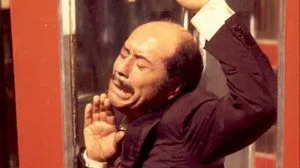
The sheer amount of content that fit inside Mercero's phone booth and into 30 minutes is striking: it reflects a passive society — even amused — in the face of a stranger's problem, whose solutions almost exclusively involve the use of force, and whose public services, like the police and fire department, turn out incompetent and barely respected. On the other hand, the number of possible readings of the story tends to infinity: it can look like a subliminal critique of the Franco regime then in power, or a metaphor from a psychological standpoint of human nature itself, prey to closed booths like routine, work or loneliness. And this aspect is no stranger to the creator, who has always defended with a certain delight that the story doesn't pretend to step outside the field of science fiction and that it leaves a reading open to the observer: every individual may find themselves trapped in a completely different booth.
The impact of the film, broadcast on the public television that monopolized the medium at the time, was overwhelming and left as its mark a public fear of phone booths: for many months no one dared close the door when making a call, to the point that López Vázquez himself had to star in Telefónica ads where he was seen leaving the booth to convey safety. Plus, the work would be translated and would gradually gain international relevance until even winning an Emmy. Its images were burned into the popular imagination until, finally, the protagonist of the story would step out of the ethereal to become tangible and palpable.
In tribute to Antonio Mercero, who died in May 2018 and with other unforgettable titles to his name (Verano Azul, Farmacia de Guardia, etc.), a proposal was born and recently approved by the City Council — and it's nothing other than the installation of a red phone booth on the same street where the medium-length film was shot, in the Arapiles neighborhood, planned for 2019. This way, a ground-breaking cinematic experiment and its author will be immortalized; an act of love for the absurd as a means of expressing very un-absurd things will be represented; and 30 minutes that Kafka would no doubt take his hat off to will live on forever. Because the fastest transport to go from Madrid to Prague, friends, is none other than Mercero's red phone booth.