If you're a regular follower of the Wake Up Tours blog, you'll surely have read about the number of metro stops that owe their names to different men, soldiers, generals, writers, doctors or philosophers. In fact, we've barely talked about the politicians who lived up to the early 20th century… so we still have a lot to talk about. But are there as many women as men represented on the Madrid metro? The sad truth is no. There are barely 10, counting writers, aristocrats, virgins… however, today we'll set the latter aside and talk about the real women, the ones we should all know.
LINE 5.
- Eugenia de Montijo (1826-1929): if you ever thought we had nothing to do with Napoleon… you were wrong. Eugenia de Montijo was the wife of Emperor Napoleon III and, therefore, Empress of the French. She was married to Napoleon, then president of the Second French Republic, when he was rejected by Princess Adelaide
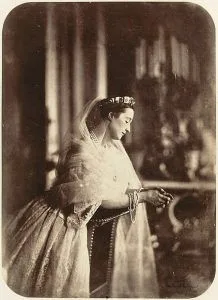
(England). Luckily for women, she didn't only play the role of wife and mother but knew how to take part in her country's foreign policy. Her presence was decisive for French actions in Italy and in Mexico, with the empress siding with Emperor Maximilian, which caused her popularity to fall among her compatriots. Add to this the French defeat in the Franco-Prussian War and the subsequent death of her husband, which led her to leave France. After the death of her young son, the former empress was traveling through numerous European countries like Spain, Germany or England. She died in Spain in 1920, but her remains rest in Farnborough, alongside Napoleon III and Louis Napoleon, her son.
- La Latina (1465-1535): Beatriz Galindo, popularly known as La Latina, was a cultured woman, author of Notes and Comments on Aristotle and Latin Poems, lady of the Court of the Catholic Monarchs. Plus, her nickname comes from the conversations she held in Latin with Queen Isabel. Her early interest in culture influenced her parents' decision to point her life toward the convent — something completely typical at the end of the 15th century — where she could continue her growing interest in letters; the only problem is that she wasn't entirely a fervent Catholic. Her fame as a grammarian and writer reached Isabel the Catholic, with La Latina becoming part of the court. With her, she frequently spoke and apparently practiced Latin. Beatriz, as she would prove throughout her life, in addition to being an educated woman, must have been well endowed with intelligence for public affairs and business.
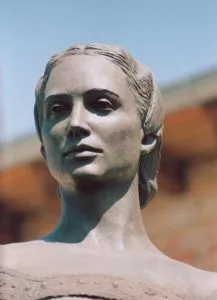 Queen Isabel especially promoted the interventions of the women of her Court in the spaces of religion and culture; she cared about religiosity and raising the cultural level, and Beatriz faithfully followed the Queen's policy, although political power was reserved for men. Isabel had ascended the Crown of Castile, and Beatriz Galindo, although she had no legal basis to intervene in Madrid's municipal politics, found the right means to get what suited her in this town. The religious foundations in Madrid and the support for the recently created Conceptionist Order — the favorite of Isabel and the women in her circle — clearly demonstrate Beatriz's political presence in Madrid's municipal life after her widowhood… Much more could be said of Beatriz Galindo; from now on you'll remember the Barrio de la Latina not only for its Sunday flea market, but for the figure of Beatriz.
LINE 7
- Lacoma: Margarita González Lacoma, Countess of Lacoma. She was the creator of the haute couture company "Marcudos", though more famous is the creation of the Colonia Lacoma, in the Peñagrande neighborhood — a housing space dedicated to workers.
LINE 9.
- Concha Espina (1869-1955): Concepción Espina was born into a wealthy Madrid family of Cantabrian origin. From very young she showed a mature interest in literature, especially poetry. In 1888 she published Azul, under the pseudonym Ana Coe Schip. After her marriage and trip to Chile, it was here that she developed her career, publishing her first works and collaborating with newspapers like El correo de Buenos Aires. After her return to Spain, in 1907 she won a literary contest for the work El Rabión and, two years later, her first novel La niña de Luzmela would see the light. Her style is at times difficult to pigeonhole, sitting between Romanticism, costumbrismo, realism and regionalism. In 1916 La Rosa de los Vientos would be made public, although the work that elevated her internationally was El metal de los muertos, inspired by the workers' strike at the Ríotinto mine.
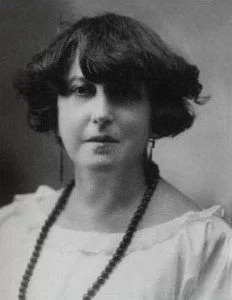 In 1928 her candidacy for the Real Academia Española was proposed. She traveled to the United States, invited by Middlebury College, and also to Cuba, Santo Domingo and Puerto Rico, in a cultural representation at the request of Alfonso XIII. There she praised Spanish culture, traditions, religiosity and idiosyncrasy, while commenting on her novels in several conferences. In New York she was awarded the Hispanic Society's Medal of Art and Literature, an institution of which she would be vice-president in 1943. The Civil War surprised her summering in Mazcuerras, where she would remain until the arrival of two of her children. During the conflict she sided with the rebel side and was a firm defender of the Falange Española, of which she was a member. In 1945 she was proposed, again unsuccessfully, as a candidate for the Nobel Prize in Literature. Concha Espina's last novel appeared in 1953, titled Una novela de amor and narrating the close youthful love affair between Marcelino Menéndez Pelayo and his Andalusian cousin, Conchita Pintado. Concha Espina died at her Madrid home on Calle de Alfonso XII on May 19, 1955, when she was writing an autobiographical novel.
LINE 12
- Manuela Malasaña (1791-1808): due to her premature death at 17, she's known as the Madrid heroine against the French repression. According to the most widely circulated version, this young Madrileña perished alongside many other patriots defending the Monteleón barracks, the only one that supported the popular revolt against Murat's troops. However, exactly how Manuela died isn't known for certain, but what is certain is that she became a real symbol of struggle and rebellion. Recently, Manuela Malasaña's biography has taken a new turn. According to the latest research, this seventeen-year-old young embroiderer didn't die on May 2, but on May 3, and was killed in the middle of the street by one of the many French patrols crisscrossing the city disarming
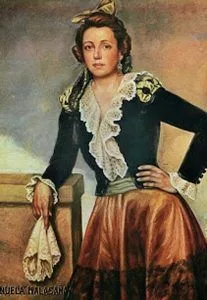 the locals. When the soldiers found the scissors the girl was carrying, they applied Murat's barbaric order, which mandated the execution of anyone carrying weapons without permission. But whether as defender of Monteleón or as innocent victim of Murat, in the collective imagination Manuela symbolizes the courage of the people of Madrid. Hence the successful spread of the Malasaña myth, a name in which an entire neighborhood of the capital is recognized today.
From Wake Up we hope you've learned a little more about Spanish history, but above all about the city of Madrid. We still need to cover some other women of relevant importance to know where we move when we travel. But due to her royal status, we'll leave it for another post. Up for getting to know a bit more?